When Mastery Becomes the Enemy: The Hidden Cost of Getting Really Good at Paddling
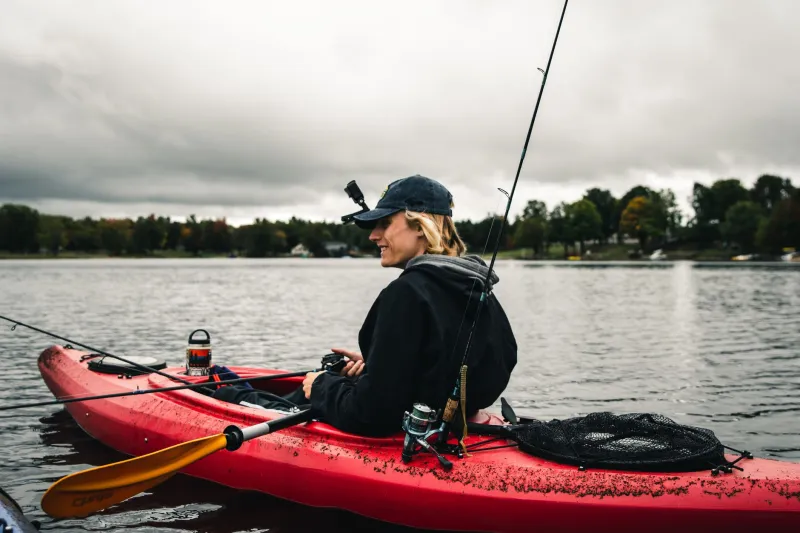
There's a moment most paddlers can point to — not a first roll, not a clean line through a technical rapid, but something quieter and more unsettling. It's the moment you realize you're not having fun anymore. Not really. You're analyzing, critiquing, competing — with yourself, with others, with some invisible standard you picked up somewhere along the way. The water is the same. The boat is better. But something essential has gone sideways.
This is what some paddlers quietly call the progression trap. And it's more common than anyone likes to admit.
The First Time It Feels Like Work
Ask almost any recreational paddler why they started, and the answers are beautifully simple. The quiet. The movement. The feeling of being somewhere that most people aren't. There's no technique in that. There's no scorecard.
But paddling has a way of rewarding effort. You take a lesson. Your forward stroke improves. You run a Class III you were scared of six months ago. That feedback loop is intoxicating — and it's also where the trouble starts.
Marcus, a whitewater kayaker based out of Asheville, North Carolina, describes hitting a wall about four years into serious paddling. "I'd gotten pretty solid on Class IV," he says. "And suddenly every time I was on easier water, I was bored. I couldn't just be on the river anymore. I was always either disappointed it wasn't harder or stressed that it was." He pauses. "I'd basically ruined my ability to enjoy 80 percent of the rivers I used to love."
His story isn't unusual. The same pattern shows up across disciplines — sea kayaking, SUP racing, canoe touring. The more you know, the more you notice what you're doing wrong. And the more you chase the next benchmark, the harder it becomes to find satisfaction in where you already are.
How Technique Becomes a Trap
Skill development is genuinely valuable. Nobody's arguing against learning proper paddle mechanics or understanding water reading. But there's a version of technical focus that quietly colonizes every moment on the water.
Susan, a flatwater touring paddler from Minnesota who's been on the water for nearly two decades, describes it as "always being in your own head as your own coach." She spent a couple of years so focused on her forward stroke efficiency that she stopped looking at the shoreline. "I was on some of the most beautiful lakes in the country and I was staring at my paddle blade," she laughs. "My husband finally said, 'Do you even see where we are right now?' I didn't, really."
The technical obsession often gets reinforced by community. Online paddling forums and social media have a way of accelerating the progression treadmill. Gear upgrades, mileage logs, difficulty ratings — it's easy to absorb the message that the point of paddling is to become a better paddler, rather than to actually be a paddler.
The Ego Current Nobody Talks About
Competition — even informal, unspoken competition — has a way of changing how water feels. When you start measuring your experience against others, you're no longer fully in your own experience.
Derek, a SUP racer from Southern California who competed regionally for three years, says the shift happened gradually. "Racing was great at first. It pushed me. But after a while I couldn't do a casual paddle without mentally clocking my pace, comparing myself to whoever was nearby. I was miserable on a beautiful day in the Pacific because some guy in a rental board passed me." He eventually took a full season off from racing. "I had to go back to being a beginner in my own head before I could enjoy any of it again."
That phrase — becoming a beginner in your own head — comes up repeatedly when experienced paddlers talk about recalibrating their relationship with the sport.
Finding Your Way Back to the Water
The good news is that this isn't a permanent condition. Paddlers who've worked through the progression trap tend to describe a conscious, deliberate reset — and the strategies vary as much as the people.
For some, it means deliberately choosing easier water. Not as a step backward, but as a gift to themselves. Marcus started scheduling one "joy paddle" a month — a mellow float on a river he knew well, with no performance goals and no technical focus. "It felt almost rebellious at first," he admits. "But it reminded me why I started."
For Susan, it was switching disciplines temporarily. She borrowed a friend's canoe and spent a summer re-experiencing the water as a relative novice. "Beginner's mind isn't just a cliché. When you're learning something new, you're too busy figuring it out to judge yourself."
Derek found his reset through teaching. Introducing new paddlers to the sport reminded him of what the water actually offers before all the metrics get layered on top.
The Permission You Didn't Know You Needed
Here's the thing nobody says out loud at the put-in: you're allowed to be good at paddling and still choose not to perform. You're allowed to take your best boat to the easiest water and just drift. You're allowed to skip the debrief about what you could have done better and just talk about how the light hit the river at mile four.
Getting better at this sport is worth pursuing. But not at the cost of the reason you got in the boat in the first place.
The current doesn't care about your stroke rate. It never did. Sometimes the best paddle you'll ever take is the one where you stop trying to make it mean something and just let it carry you.
You earned that. Go find it.